

Everyone Wants Clean Energy. Just Not in Their Backyard?

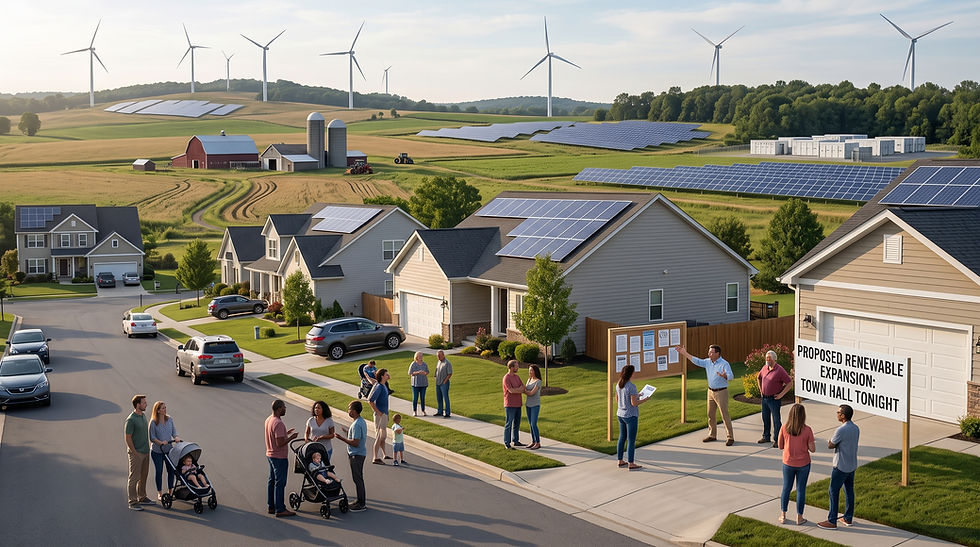
We want reliable electricity, lower emissions and affordable energy. Preferably without having to look at any of the infrastructure that makes it possible.
There's something fascinating about our relationship with electricity.
We want more of it. We want it to be affordable. We want it to be clean. And we certainly expect it to be available whenever we flick a switch. But mention a solar farm, a wind turbine or a battery storage facility in someone's neighbourhood, and suddenly the conversation becomes a little more complicated.
Welcome to the great renewable-energy paradox.
The electricity isn't going to generate itself
According to Ontario's Independent Electricity System Operator (IESO), electricity demand is projected to grow by approximately 65% by 2050.
That's a lot of additional electricity.
Electric vehicles, expanding industries, growing communities and the electrification of buildings are all contributing to a future where electricity will play an increasingly important role in everyday life.
And here's the inconvenient truth: wanting more electricity without building more infrastructure is a bit like wanting better public transit without buses, trains or tracks.
Something has to give.
But communities deserve more than a sales pitch
To be fair, concerns about renewable-energy projects aren't always unreasonable.
People have legitimate questions about agricultural land, environmental impacts, noise, safety, property values and who ultimately benefits from a project. Those questions deserve thoughtful answers, not an eye roll. But there's an important difference between asking questions and deciding that no solution is acceptable.
Solar panels don't have to be installed everywhere. Wind turbines aren't appropriate for every location. Battery storage requires proper safety planning and oversight.
Good energy planning means choosing suitable locations, considering alternatives and involving the people who live nearby.
It doesn't mean avoiding the conversation altogether.
What if communities had a bigger say?
That's where community participation becomes especially important.
At OREC, we believe renewable energy shouldn't be something that simply happens to communities. It should be something communities can participate in, help shape and potentially benefit from.
Community-owned energy offers a different perspective on development: one that places local participation alongside the technical and financial decisions.
And that brings us to the Thumbs Up for Renewable Energy campaign, led by CAFES Ottawa in partnership with OREC.

The campaign is encouraging residents to learn more about local solar generation, battery storage and the role these technologies can play in Ontario's energy future.
It's an opportunity to move beyond the usual arguments and ask a more constructive question:
If we know we'll need more electricity, how do we build an energy system that communities can actually support?
Because electricity doesn't appear by magic.
And if we want a cleaner future, eventually we're going to have to give some real-world solutions a chance.
Give renewable energy a thumbs up. Learn more about the campaign and add your voice here.


Comments