

Community Power: Why Co-ops Matter More Than Ever

Updated: 14 hours ago

A few weeks ago, I had the privilege of joining a panel on project financing at the Community Energy Co-operative Conference (CECC) Annual Forum.
Being in a room full of peers committed to community-owned power was energizing. During our panel discussion on navigating Ontario’s post-FIT clean energy market, our team shared how OREC has continued to grow and diversify—scaling to 1,200 members, $16 million in invested capital, and 32 operating solar, wind, and retrofit projects across the province. The conversation quickly turned to the systems, digital tools, and financial models that make that work possible.
Conferences like CECC are valuable because they pull us out of day-to-day operations and remind us of the foundation we stand on. For renewable energy co-operatives, that foundation isn't just engineering specifications, financial spreadsheets, or kilowatt-hours. It is the 7 International Co-operative Principles.
As Ontario faces rising electricity demand, shifting energy policies, and the urgent need to decarbonize affordably, these seven principles serve as our operating compass.
What Makes a Renewable Energy Co-op Different?
Unlike traditional energy developers funded by distant private equity or private shareholders, a co-operative exists to serve its members and strengthen its home region. As a for-profit co-operative, OREC invites everyday Ontarians to pool their capital, earn a fair financial return (including through RRSPs and TFSAs), and retain democratic ownership of local clean power.
Our sector is a community of its own. Across Ontario and Canada, organizations like our peers at SolarShare and fellow members within the CECC network share this common vision of community-driven energy transition.
Here is how the seven principles shape what we do every day:
The 7 Principles in Action
1. Voluntary and Open Membership
A co-op’s strength comes from broad, accessible participation. Membership is open to all who share the vision of building clean, community-owned energy. Over the past several years, we’ve prioritized reducing friction for members—launching our MyOREC portal to make local green investing as straightforward as standard online banking.
2. Democratic Member Control
Co-operatives are democratic enterprises governed by "one member, one vote." Our members elect our Board of Directors, shape high-level direction, and hold leadership accountable. Whether evaluating new technologies or expanding into regional partnerships, our decisions reflect the democratic mandate entrusted to us by our 1,200 members.
3. Member Economic Participation
In a co-operative enterprise, capital serves the mission—not the other way around. Members contribute capital and share in the economic benefits through dividends and fixed returns on investment notes. Maintaining financial rigor—such as requiring healthy project yields (typically 8–10%+) to cover debt servicing and weather operational unknowns—protects our members' investments and ensures long-term viability.
4. Autonomy and Independence
When regulatory programs like the Feed-in Tariff (FIT) wound down, independent co-operatives had to adapt to survive. OREC maintained autonomy by establishing commercial net-metering projects—such as our 914 kW rooftop installation at the Canada Science & Technology Museum—and acquiring existing clean energy assets like the Tiverton wind turbine. Autonomy means building a balance sheet resilient enough to thrive under any political or regulatory climate.
5. Education, Training, and Information
A core responsibility of leadership is demystifying the energy landscape. Between rising delivery charges, transmission bottlenecks, and questions surrounding natural gas reliance, the grid can feel opaque. We work to keep our members informed about distributed energy resources (DERs), while using showcase installations to educate the public on the practical benefits of local renewable generation.
6. Co-operation Among Co-operatives
Co-operatives achieve far more together than in isolation. The CECC Forum was a clear reminder of how vital peer collaboration is. Whether participating in regional networks, sharing project learnings with organizations like SolarShare in Toronto and SES Solar Co-operative in Saskatchewan, or exploring joint financing mechanisms, strengthening ties between co-operatives is essential to proving that community energy can compete at scale.
7. Concern for Community
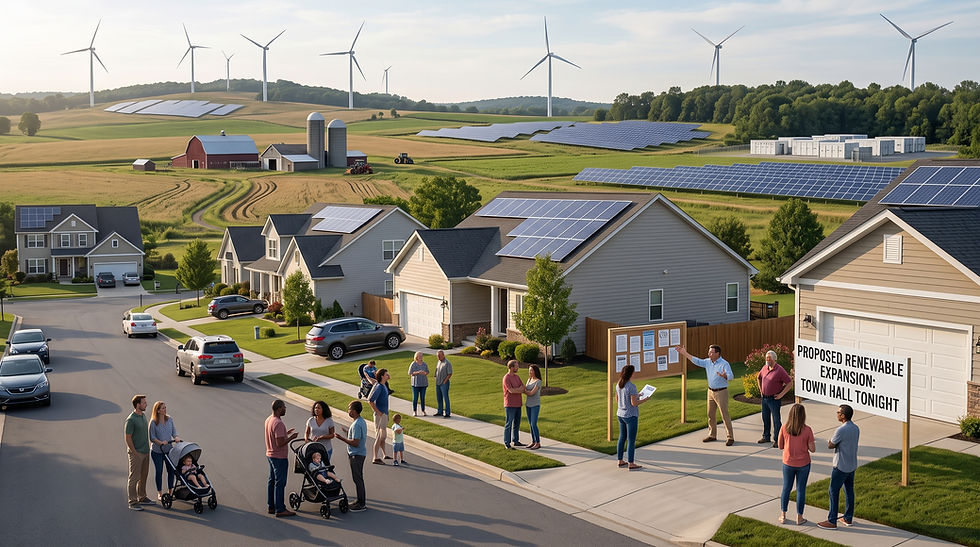
Every rooftop solar panel, battery pilot, and wind turbine we operate is anchored in a local community. Decentralized power keeps energy dollars circulating locally, reduces strain on centralized transmission corridors, and contributes directly to reducing Ontario's carbon emissions.
An Inflection Point for Community Power
Returning from Montreal, I was reminded that while the technology of power generation changes rapidly—from solar modules to battery storage—the principles of co-operation remain timeless.
More importantly, we are arriving at a pivotal inflection point. Across Ontario, multi-billion-dollar investments are being directed into large-scale nuclear builds and refurbishments. Federally, massive capital is flowing into pan-Canadian transmission corridors. Yet both of these centralized, capital-intensive strategies continue to be backstopped by expanding natural gas generation to meet near-term demand peaks.
Centralized mega-projects alone cannot deliver a truly resilient, affordable, or democratically owned grid. With Ontario’s planned Local Generation Program (LGP) on the horizon, the opportunity for distributed, community-led power has never been greater. It is a critical moment for renewable energy co-operatives to amplify our collective voice, champion local generation, and prove that clean energy works best when communities have a stake in the outcome.
Balancing day-to-day project execution with broader sector collaboration is always an ongoing governance priority for our Board and management team. As always, our members' perspectives, questions, and insights are a welcome part of that dialogue.
If you have thoughts on how OREC can best champion the co-operative principles in today’s energy market, please share your thoughts in the comments below or reach out directly.
Be Part of the Solution: Join OREC Today
Clean energy resilience isn’t dictated from the top down—it is built from the ground up by citizens pooling their collective resources to power their communities.
Whether you want to invest tax-sheltered TFSA/RRSP dollars into local renewable infrastructure or participate as an active voting member in our democratic co-operative, there has never been a better time to get involved!


Comments