

Norway’s Quiet Revolution: Twelve Days on a Low Emissions Cruise


Cruise ships have a well-earned reputation for environmental impact — and for the eco-conscious traveller, the carbon, NOx, and SOx emissions can be hard to justify. But Norway is quietly rewriting that story, and a voyage along its historic coastal route offers a compelling glimpse of what sustainable sea travel might look like.
The 9,260km journey from Bergen north to Kirkenes and back — almost two thirds of which is in the Arctic Circle — takes six days one way, or twelve days as a round trip. Two operators, the long-established Hurtigruten and the newcomer Havila, run regular postal ferry services along this corridor, serving thirty-four coastal communities with freight, local passengers, and cruise guests. The route has existed for over 130 years; cruise travellers are now an increasingly significant part of the mix.
Norway is pushing the industry hard. Zero-emission rules will apply to UNESCO fjords by 2032, with requirements being phased in progressively for smaller vessels.
On Board the Havila Polaris
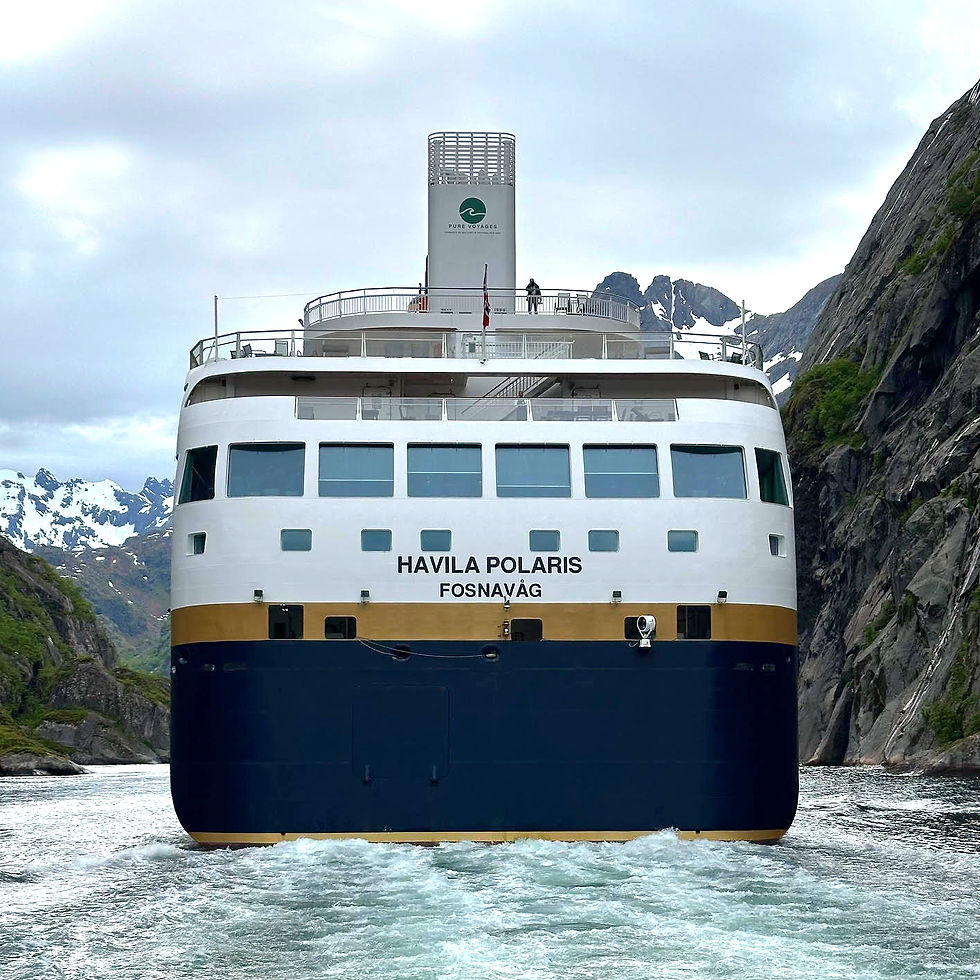
We joined the Havila Polaris in May 2026, one of four Havila vessels each offering 179 cabins. What sets these ships apart is their gas/battery-electric hybrid propulsion — quieter, cleaner, and more versatile than conventional cruise ship engineering.
In December 2025, the Polaris completed its entire twelve-day round voyage on battery-electric power and biogas alone — which Havila declared to be the world’s first “climate-zero cruise.” The numbers behind that claim are striking. A standard liquefied natural gas (LNG) voyage produces around 650 metric tons of CO₂ — already roughly 30% less than diesel. Switching to liquefied biogas (LBG) brings that figure down to just 50–55 metric tons: a further 92% reduction. The small residual emissions are offset, allowing the journey to be formally certified as climate-neutral.
Rather than extracting new fossil fuels, LBG is produced from Norwegian fish-processing and agricultural waste — material that would otherwise decompose and release damaging methane into the atmosphere.
The ship’s battery system is equally impressive: 6.1 MWh of capacity, the largest ever fitted to a passenger vessel. The Polaris can run on battery alone for up to four hours, recharging at ports or switching to gas generators as needed. Sailing through the fjords with the gas engines off and near silence save for the ripple of water and sounds of nature seemed to fit well with the natural beauty of Norway .
This contrasts with the vast majority of modern cruise ships, which use electric azipod propellers but depend entirely on large diesel generators, with no meaningful battery buffer and no ability to charge from shore.
Getting to Zero
Until now, regular Havila sailings have run on LNG, which already cuts NOx emissions by around 90% compared to the heavy oil most cruise ships burn. The company’s target is to phase out LNG entirely by the end of 2028, switching all sailings to LBG from suppliers including Barents Naturgass, Molgas Energy, and Titan Clean Fuels.
The ambition is credible — but crew members were candid about the obstacles. Biogas remains significantly more expensive than LNG and is not yet reliably available at all ports along the route. Building the bunkering infrastructure to support consistent LBG supply, across a 9,260km coastal corridor, is a genuine logistical challenge. It’s a useful reminder that even when the fuel technology works, scaling it depends on solving supply chains, port facilities, and commercial economics simultaneously.
Efficiency Beyond the Engine Room
The environmental thinking doesn’t stop at propulsion. Waste heat from the engines is captured and redirected to warm cabins and heat water. And in a notable departure from cruise ship convention, there is no buffet on board. That single decision is estimated to reduce food waste by around 60 tonnes per year. Havila monitors waste carefully, targeting no more than 69 grams per passenger per day.
Norway Beyond the Ship
After twelve thoroughly enjoyable days on Polaris, we returned to Bergen. An EV taxi took us to the station and an electric train carried us to Oslo. Touring Oslo, we took electric trams and battery electric buses. In Oslo harbour, we visited the islands on a battery-electric ferry. On our vacation from the open sea to inner fjords, city waterfront and urban areas — clean and quiet propulsion was simply the norm.

Norway hasn’t just embraced electrification; it has made it unremarkable—a way of life—which may be the most radical thing of all.
Paul Haskins
Vice-President, OREC


Comments